Charlotte E Animation
Narrative Design & Concept Art Project
The Brief
For this project, I am working on a crowd funded game looking to secure investment. It is a fantasy game similar to The Witcher, The Legend of Zelda and Ori and the Blind Forest. It requires a narrative overview of a game of my own design as well as some concept art for it. I need to research a variety of games and other media that include stories and characters that I enjoy. Additionally, I need to research and analyse other concept art. I also need to write a treatment sheet for the game's story with the accompanying development and final concept artworks. I plan to look at a few fantasy games and other media I enjoy and their concept art, as well as some additional concept and character design artists that I like in order to inspire me for this project. I will then evaluate my final concept artwork as to how it fits the brief.
Contextual and Visual Research:
Fantasy Video Games

Hades II
Hades II is the sequel to Hades where you play as Melinoë - daughter of Persephone and Hades and sister to Zagreus (the first game's protagonist) - on her quest to descend into the depths of the Underworld and defeat Chronos, who has taken over her families house. Both games are inspired by Greek myths and are adapted for more modern audiences. The narrative follows a heroes journey - with Melinoë - the hero - training her whole life for her confrontations with Chronos. As a character, she is very single minded about her task and struggles to see other peoples perspectives on the previous age of the Gods and how they deal with mortals. I think she suits being the hero as she is directly tied to the problem giving her agency as well as the way she was raised to complete her task being reflected very clearly in her character - she is strong and devoted yet flawed in her thinking. Additionally, there is a large cast of characters in the game, such as her allies against Chronos, the Guardians in between each region and the Gods providing her with boons. These characters each have their own clear personalities and roles that are adapted very well for a modern audience from their original myths. For example, Hecate is clearly a mentor to Melinoë who although stronger, she cant complete the quest herself since she
must guard the Crossroads. This reflects her role in the myths as a protective deity who would cast spells to guides those in the underworld. In regards to setting, each region in the game takes on a different archetype with unique encounters, such as The Crossroads being a garden as their place of safety and Erebus being a forest for it is wild and natural. I enjoy the witchy themes that many of the characters have and the symbols tied to them. All of the silver sisters have moon accents on them which can be seen and reflected in the design of Selene, giving a clear link whilst also connoting their power and femininity. Additionally, there is the hourglass symbol surrounding Chronos as he is time incarnate, as well as the game making plays on him being time when you fail - "Time Cannot be Stopped". Focusing on Chronos still, I really like the theming of the characters - there is dialogue with mentions of time, being unable to use boons that alter time in his fight and even being unable to pause your game during the final fight against him.
For my own narrative, I am inspired by the games wide variety of settings and encounters that you can come into as well as the use of symbolism to tie characters to one and other as well as what they are the embodiment of as Gods and Titans. I will try to take inspiration from these factors for my story by perhaps making it a game where you can travel to multiple locations with different conditions such as a safe space and combat areas or where the environment can change based on what you do in the game. In regards to linking between characters - I might incorporate symbols into their designs that reflect their personalities or their relationships between other characters. I also wish to take inspiration from there being a wide range of characters that can be met throughout different locations and each characters is very distinct. While I wont come up with concept art for 20+ characters it is interesting to think of what different kinds of people that main character could meet throughout their story.


In my view, the art of the Hades games is defined by its intricate details, exaggerated features, vibrant colours and clear boundaries between light and dark. The second game includes lots of redesigns for previous characters, so there are already existing concepts but I like how the new designs reflect how a character has grown. For example, Aphrodite is now predicted bearing weaponry and in a less relaxed pose than her design in the first game. Another thing I enjoy about the style is that the characters all look human but if you look at the details there are fantasy elements that may go more unnoticed - like Hestia's hair burning up like fire and the eye decoration on Hades' capes that you can't quite tell if they are moving or not. According to lead artist Jen Zee in an interview with Creative Bloq, when designing the characters for Hades II they mainly try to focus on tone and theming of the designs by taking the top 3 tonal qualities that a character will embody just by looking at them - the example being Odysseus as "rugged, cool and neighbourly". I think the character designs do a good job at this and would like to incorporate that into my own concept art - in the game you can tell what a character is going to be like without knowing them that well due to their expressions, poses and their visual elements. I also love the way things are coloured in the games art. The colours are bold and each scheme links characters together - for example Melinoë orange and teals match the tassel Hecate's hat. Additionally, the designs have lots of random dots of colour in them which seems like it would be jarring but actually adds more vibrancy and sharpness to the designs. Furthermore, they use lots of solid black shadows and pure white highlights which creates further contrast and vibrancy in the artwork. Even in the enemy designs, the way they look clearly links them to their surrounding environment and gives tone on the difficulty of the area. For my concept art, I will take inspiration from the colourful, saturated designs and the cohesiveness and contrast between characters. I also want to be able to convey danger and a similar theme across different locations in my game with the environment, people and enemies you can meet in each one. I think the concept art does a good job at creating cohesion and displaying emotion and relationships through all their designs and I wish to reflect this in my designs.
Slime Rancher
Slime Rancher follows the adventures of Beatrix LeBeau - a young rancher who has travelled 1000 light years from Earth for a life on the Far Far Range where she spends her time exploring and wrangling slimes. The game mostly revolves around exploration and growing your ranch but the story comes through messages from others. You start by knowing very little about Beatrix and only learn the information about her through letters in the Starmail from Casey - an old friend or perhaps partner who misses her on Earth. Most of the letters shared between them are reflecting on old memories and connecting them to their present. It is implied that Bea writes back although the player never gets to read those letters. In these letters Casey tells stories of how she wanted to confess her feelings to Bea but was unable too before they had a year apart from eachother where Bea went to explore the world and Casey went on tour with her band. In that time they had lost the spark between them and Casey never confessed her feelings. Eventually, the two stopped seeing eachother with Bea going to the Far Far Range. As put in one of the letters "what we really want just so happens to be in different parts of the known universe". Although there are many more stories in the game to encounter besides theirs such as

Hobsons story - the parallel to theirs. You can speak on the phone to a woman named Thora who tells you almost nothing about herself other than her relationship to Hobson. He inhabited the Far Far Range's ranch before Beatrix did and he had left a series of notes across all the locations you can travel to. There will be information about how to play like avoiding the Slime Sea in his notes but they mainly detail his life and love with Thora and how in life you must always choose between the things that you want. He could either unlock the teleporter at the farest point of the Range for the ultimate adventure, or put it all down to stay with his love. He chose to stay with Thora and reminds Beatrix to use her head but let her heart do the thinking every now and again. Their is no right choice but both chose different paths and are both happy with the outcome of their decision. The second game is currently in early access and follows Bea as she goes to a new location - Rainbow Island - where there are many ancient mysteries to try and solve alongside new notes being left by a currently unkown source. There are many locations in the game with the Ranch being your home base and then increasingly dangerous and mysterious places the farther out into the range you travel. Some of these locations include The Glass Desert and The Ancient Ruins which are both old wastelands with unpredicatable weather and events that make for interesting and visually stunning places to explore. I really like the ancient untouched landscapes that are across the Range and the connotations that something was there before, even though we never discover what and if there was anything. There are evil corrupted slimes called Tarr that can be found exploring who will ty to eat other slimes but there is no villain specifically out to get Beatrix. I like that the game has challenges in that way but also I enjoy the uniqueness of the story being told through old notes reflecting on life rather than there being a big villain to fight at the end.
For my game's narrative, I enjoy the variety of ancient landscapes and mysteries and the fact that you have to explore the different settings and their ruins in order to discover the current story as well as speculating about what has happened in the past. This inspires me to perhaps set my game in a place that has an abandoned ancient history as I really like the theming of the far away abandoned land. Additionally, I like the slimes that can be found across the area and how they are also themed to their location - like mosaic slimes in The Glass Desert. I will perhaps include and design some neutral fantasy creatures or companions for the characters that are thematic and also have a cute, recognisable design. I also really like the parallel stories due to how they reflect the main characters life and also having multiple ongoing narratives is very interesting to me. This might influence my game by having characters or narratives that are foils to eachother or maybe having a story to follow in both the past and present.


The art of the first slime rancher game was very pretty but the colours do remain rather flat with more major textures in the environment - but the second game has a lot of improvement in the texturing and details. I find that the colours flow together much more smoothly and it looks for 3D. I like how it is still similar to the first game but just builds on and improves it to make some beautiful environments. In regards to Slime Rancher's concept art - made by Ray Bruwelheide - I really like the reliance on shape and colour over line work which is more of a unique approach to concept art that I've seen. I love the colours in the artwork of Rainbow Island especially the unnatural, multicoloured landscapes. It really reflects the mystery and fantasy of an untouched alien landscape. I also love the contrast of the soft, natural landscapes against the sharper, industrial look of the ancient ruins and teleportation circles. Although, the architecture still has an iridescent and magical look to it which unites it with the environment and the slimes that roam it. This may influence my artwork as I really enjoy the exploration of age old ruins alongside the overgrown landscapes that come from being an uninhabited location and I think the games artwork does a beautiful job of depicting this relationship. One of my favourite areas visually in the first game was The Glass Desert because it felt very unique and had a unique restoration mechanic, where you could use ancient fountains and water to create oases where vibrant foliage would grow against the desert landscape to be a safe haven when battling against the extreme weather and tarr outbreaks. I really like the iridescent glass pillar depicted in the concept art for this area and it gives me inspiration for my own art and narrative to perhaps have a deserted location that needs restoration with a clear nexus point similar to the tall towers and multicoloured glass shards found in his location. Additionally, the designs of the slimes in this area are some of my favourite - with mosaic slimes reflecting the aforementioned prismatic shards, tangle slimes growing and moving like vines from the restored lush plants and dervish slimes appearing with rings and swirling animations in the desert sandstorms. Once again I am inspired by the theming of different aspects together, in Slime Rancher's case it being the slimes to the location and I would love to reflect the unity between different aspects in my own games concept art.
Visual Research:
Additional Concept Art
Eliza Stark


Eliza Stark is a fantasy and historical inspired character and costume designer. I really like her clothing designs as they look practical and like something that an adventurer would wear whilst still having the elegant, magical details of a fantasy design. I like the amount of personality that is carried through each design, especially with the belongings and accessories being displayed alongside the outfit. I like the organic shaping of the materials like the puffed sleeves, draped fabric and folds which reflect how the clothing would look on a person. The detailing and theming on the outfits is also very appealing - for example the 3rd bottom row image has many lunar motifs alongside the dark purple colours, conveying the magical nature of the character wearing it. I like the individual colour pallets that are slightly muted on each design and although they are all clearly in her style, each costume is very individual. I enjoy the fact that you are able to see all the elements separately but would like to see these designs on a person with all the layers together in order to get a complete picture and see if the outfit actually suits who it is on. For my concept art, I am leaning towards a character design with a witchy, sorcerer type look and I plan to take lots of inspiration from Stark's artwork as I love the draped, layered look of the outfits. Additionally, I want my characters outfit to look practical for what they are doing but I still don't want it to be boring, so I plan to take inspiration from the designs that have something to protect their legs, high boots and tightness around the arms but it may still have some vibrant patterned fabrics or exciting shape to it so that they are still stylish.
Hannah Alexander


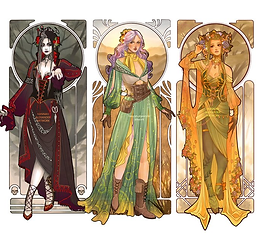


Hannah Alexander is a fantasy illustrator and costume designer inspired by Art Nouveau and game concept art. Her portfolio consists of original illustrations but she is most known for her elaborate costume redesigns for pop culture characters. I love the complex and over the top outfits she designs as well as her ability to take an existing design and make it seem refreshing and unique whilst still keeping the characters original essence. I am especially inspired by the way the characters are framed in the finished illustrations of her Art Nouveau posters. I like the natural background that relates to the character as well as the shapes it is held in that highlight the characters top portion. I like the individual cut symbols and lines in each illustration - for example the skulls at the base of Laudna's design - as they reflect the character's personality and features. This inspires me to perhaps add my own framing or backgrounds to my concept art for any characters I design. Similarly to Stark's artwork, I love the layered, draping fabrics on the designs that give the costumes a very elegant feel - but as I previously mentioned I want a more practical look for my character design, but I will still take inspiration from the way the fabric flows and falls. Additionally, I love the colours on the designs, especially those that appear as if they are in a sunset and those that are effected by the environment behind them. The linework is also very interesting as it is softer and blends more with the image inside of the character, but they have the bold black outline surrounding them. I enjoy how this draws focus and separates them from the background since there is a lot going on behind them. For my concept art, I hope to use the same vibrancy and boldness that can be seen in her artworks.
My Narrative:
Treatment Sheet
Synopsis:
My game idea is an exploration and adventure RPG where you play as Junia, a sorceress who can speak with the dead and has been sent to discover the secrets of a corrupted, long forgotten island. You work for an arcane organisation based on the main continent of this world and they have sent you along with two others to investigate and cleanse this unnamed island to make it suitable for being rebuilt and lived on by a new generation. Explore the overgrown ruins of each location of the island whilst using your magic to communicate with spirits, battle monsters and tackle the mysterious corruption.
The story begins with you and your companions arriving on the island and heading in separate directions to cover more ground. On your adventures, you travel through each area, completing puzzles, enhancing your abilities and communicating with the spirits of those who once lived here before it fell. One early on will explain how they are corrupted due to the strange magic that destroyed the place and will also teach you the ability to help purify the angry ghosts so you can then choose to confront them in battle or attempt to help. If you tell spirits your purpose on their island, they will tell you how this place is theirs and that they don't want you to cleanse the island of their presence. On the other hand, you may also cross paths with your co-workers and hear their stories of how incredible this place will be once you complete your goal. At the centre of the desert you will find the final boss enemy and after its defeat you may make the choice of how you leave the island. You are presented with multiple paths - helping the spirits and creatures by giving the island to them but betraying your organisation and goal or curing the land for rebuilding but banishing the spirit friends you have met on the way. These two options both help cure the corruption in the land, but you could also choose the route of knowledge, if you wish to know the reason for the islands corruption you can choose to not cure it and instead have the opportunity to learn the ancient secrets. Based on who you talk to, the dialogue you choose and your successes and failures, you will receive information that persuades you in different directions to push you toward a decision. If you choose a healing the land option, you are able to go back through the areas and either communicate with any of the spirits you have previously met, or talk to those from the main continent and make plans for what's next depending on your choice. Additionally, as you are playing you have the opportunity to try and persuade your companions to join your side against the organisation to help the spirits and keep your friendships. The main ending would be one where you persuade your allies and remove the corruption whilst letting the spirits have the land as you return home, but the ability to play the game in different ways makes for a variety of different endings.

Setting and Enemies
The game takes place in a variety of environments but they mainly follow the forest and wastleland archetypes because they are empty, dangerous, overgrown and ruined landscapes. Although they are not completely devoid of life due to the creatures, monsters and spirits residing there. In order to progress into the next section of the island, you must deal with a guardian on the edges of the area to get access. The multiple environments with the bosses at the end are inspired by rougelike games such as Hades although my game will be more of an open world concept with multiple quests and routes to go, so you can choose if and when you progress to the next area.
The first section of the island is a tall grass field filled with vibrant and unnatural coloured foliage as well as ruins of a castle, inspired by the Rainbow Fields of Slime Rancher 2. On these plains, you might come across enemies such as possessed armour and zombies as well as neutral creatures like ghost animals. The guardian of this area is a corrupted spirit of a knight, who is bound to the keep of the castle's ruins, who you can either attempt to help or defeat.
The next section is an expansive forest that has a more eerie appearance than the former, with teal, purple and yellow colours. It looks very overgrown and is filled
with mushrooms and flowers. There are more subtle ruins here, such as old statues and well hidden cabins. You will come across more ghostly enemies as well as myconid people, dryads and living plants. The guardian of the woods is a hag type of enemy
who bars your exit with her spore and witch-like powers.
The third area of the island is built off of iridescent crystals such as alexandrite, opal and tourmaline. The landscape has lots of cave systems to explore, held together by unique erosion as well as man-made mining routes. In this location, you can come across rock and crystal creatures, beings made from the reflection of the iridescent lights on the gems and more shadowy creatures who disguise themselves amongst the vibrant rocks and lure people in with a fake gem, similarly to an illicium found on an angler fish. The guardian of this area is a sort of crystalline nymph, who you do not fight but instead complete trials where you fight monsters, complete puzzles and help her with things so that she will allow you to pass.
The final zone of the island is the centre of the strange magic and corruption. It is a desert landscape inspired by the Glass Desert in Slime Rancher and artwork of Jrusar from Critical Role. that has the colours of oxidising copper so the sand blends between orange and teal hues. The land is littered with shining glass shards and dried up plants as well as oases filled with mysterious liquids. There are creatures here like sandworms, desert mages and rocky animals as well as having to put up with weather effects like sandstorms. This place has the most grand ruins - you can see tall pillars and abandoned layered towns as well as underground tunnels filled with puzzles and gems. The centre of the desert in a ruined temple contains the final boss, a sort of primordial, multi-limbed creature who reflects the

strange rainbow colours found in each location throughout the game. Defeating or purifyingthe creature allows you to restore the desert land, filling it with lush green plants and calming any angry spirits and creatures you encountered before. I created these two mood boards to reflect what the environments, creatures and guardians that you can come across could look like.
Characters
For these character descriptions, I will be focusing on those you can meet in the first area and the ones I plan to do concept art of later on.
- Protagonist - Junia: You play as the sorceress Junia who has the ability to communicate with and see the spirits on the unnamed island. Although you make dialogue decisions, her personality comes across as motivated, inquisitive and dedicated. She leans into her witchy persona a lot, relying on her abilities to help her as well as make an impression and keep her focused on her cause. While she is devoted to her job if you play that way, she is also very interested in others which makes room for doubt and to be persuaded onto the spirits side - also further leaning into her witchy persona. Not much is known about her before the game (which was something I liked about the protagonist in Slime Rancher) therefore the main focus of her character is the different relationships she can make and the contrast between those with her living allies and the ghosts depending on the actions in the game.
- Familiar - Tella: Your familiar is a curious and sweet ghost animal - the type of animal I will decide later based on my initial concept designs - who joins you as you arrive on the island. They are a helper who assists you by doing small amounts of damage as well as making it easier to soothe spirits.
- Guardian - The Knight: The Knight is a spirit who is bound to defend the castle's main tower even now that it has fallen. The corruption on the island has caused her to be blinded by her devotion and desire to protect something that she can't realise is no longer there. She is a strong and violent fighter and stops you from proceeding by making you duel, where you an either defeat her in a fight, banishing her spirit, or attempt to purify her and from the corruption. If you do this, she will still remain at the castle, distraught after realising that she hasn't been protecting the castle, but the ancient ruins of it.
Audience:
The game is suited to those who enjoy fantasy RPGs, character levelling, NPC interactions and games where your choices matter and influence your story. There is a mix of combat, puzzles and conversation to keep gameplay varied as well as the ability to change combat difficulty to suit more playstyles.
Initial Designs
For my initial concept art designs, I am going to create my main character alongside her familiar, as well as focusing on the first location in the game by making a design for the guardian there and the area you will find her in.


I began by looking at what my game's protagonist might look like by experimenting with different hair and outfit designs. The outfits were inspired by Eliza Stark's and Hannah Alexander's work since they have lots of layers, belts and a medieval look to them. I originally found that I was trying to add as many details as possible making the first outfits look too cluttered, so I tried to simplify them more as I went on. Regarding the hair, I prefer the more curly, voluminous hairstyles out of the ones I sketched, so I will develop those further. Next, I designed a few different animals for her familiar, trying to include different ways they could move and the colours they would have as well as making them seem sweet and curious. In regards to this areas guardian, I wanted to capture a ghostly look, so I wanted long draping fabrics and for them to look like they were caught in the wind. I also wanted her to have a medieval appearance so I referenced old great swords and shields for the weaponry. The area in which you confront her in is a collapsed tower which now resembles a circular arena. I wanted to experiment with different foliage that would grow around the ruins as well as what other things from the castle would remain and how that ties to the knight herself. I came up with things like torn banners and hilts of blades that match her weapon and symbol on her shield. When developing my designs further, I need to connect my ideas more by testing the separate designs together - such as putting a head on the outfits and the weapons with the knight. Additionally, I want to test the colour pallets together since I have written down the colours I am debating using but have not actually seen them together.
Design Development:
Junia and Tella


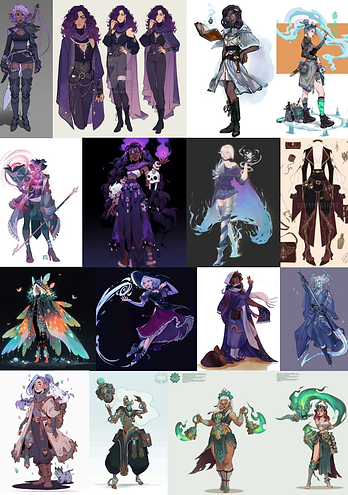
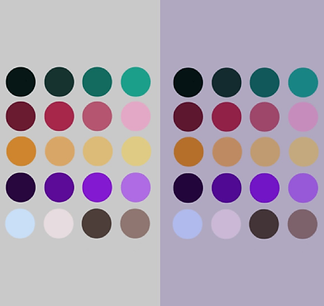
For Junia's design I took reference from my 3rd initial outfit design, which I liked the most since it felt the most witchy as well as having a nice mix of flowing fabrics and practicality with the boots and tight sleeves. I also created this mood board of character artwork that matched the colours and magical look I was aiming for. I liked majority of the left side design although I didn't like the hair and thought it needed a few more accessories so I adapted it into the design beside it. In her accessories, I included lots of beads and crystals since in witchcraft they are used to protect and ward off evil spirits. Furthermore, she has a primarily purple design since it is the colour of magic and contrasts the teal of Tella well. Her design is also quite asymmetrical with the sleeves starting at different points, gloves covering opposite parts of her arms and the skirt fabric being randomly there which creates more visual interest. Regarding colours, I am leaning more towards the right sides cooler tones since I like the pairing of purple and teal being the majority of the colours, then having a few accessories in gold and pink. Additionally, I have taken inspiration from the witches designs in Hades II and the moon motifs on the characters by having the edge of the staff being a moon shape as well as her tattoo sleeve including lunar symbols. I have taken further inspiration from Hades II's witch designs with the colour scheme of teals and purples that Hecate wears but have decided for it to be brighter than hers. The tattoo reflects different aspects of her design
such as the moon, stars, crystals and other symbols associated with death. I decided on having Tella's design to be the ghost stoat since they have a lot of interesting movements and can bend in lots of ways. To make them more ghostly, they will be translucent and have a tail that is longer, more fire-like tail than a regular stoat's to make it look like it is blowing away.
Design Development:
Knight Guardian


For the knight's design I used a combination of my initial designs, incorporating the helmet and chest plate of the first and the more defined body and armour of the second. I didn't want her outfit to be as detailed since she is a ghost and will appear transparent in colour which would mean a lot of the details would be lost and it may just look messy, so I chose to have the pink gem in the centre and then just lines elsewhere. I also liked the helmet seeming apart of her head and blending into the hair and how you can't see any of her underneath the armour, representing how her protection of the castle has become her main identity in death. To make her look more ghostly, she will be coloured transparent in the final design and I wanted the flowing hair and magic round the sword to look unnatural and like it is caught in the wind. For her weapons, I chose ones that are more heavy and bigger to make contrast with Junia's slim staff as well as showing her proficiency in strength over agility. In my final design, I want to her to have a strong silhouette and pose to reflect her emotions, since she has no visible face to show them there. Additionally, I may make the armour more sharp and pointed in place to reflect her danger as well as contrast the more round features of Junia's design.
Design Development:
Ruined Tower


The tower is where the encounter between The Knight and Junia takes place, so in its destruction I wanted it to seem more like a circular arena. I imagine this happening at night so that you can really see The Knights translucent and glowing form, so I added a dark blue layer over my original vibrant colours of the rainbow plains to reflect what they would look like at night. The Knight's sword and shield can be seen in an rusted physical form in the centre of the tower with them being the original ones she used in life. To show the age of the ruins, there are torn banners, cracked bricks, missing walls and lots of foliage growing on and around the tower to make it look like nature has reclaimed the structure. Additionally, the fields have very vibrant and varied colours whereas the ruins have muddier and harsher colours to create contrast between the buildings and nature. The tower is placed on the top of a hill where you can look down and see the rest of the plains, ruined town and even the sea when you go down the path on the way out. When creating my final piece, I may also include other teal streaks and blurred forms to show other spirits watching the encounter. I wanted the building to have a very wide base to indicate how big it would have been before it was ruined as well as representing how much The Knight had to protect if this is just one part of the castle.
Final Design Development
For my final design, I am going to create a scene where The Knight and Junia prepare to battle each other within the ruined tower. I began by finding stills shots of two people to reference for the scene and then made some rough thumbnail sketches to decide which composition I preferred.


I chose to reference some shots from Arcane that show two characters at various angles. I decided I liked the first composition the most but wanted more of the scenery to be visible, the towers area to be bigger, the characters to be slightly further apart and for Tella to be in a different place. I incorporated these into a new sketch to better display the composition then added details into the scenery and drew the characters in properly to prepare for colouring.


My next step was to draw the shapes of the background in and then add in the ghost characters since they affect the background lighting by glowing and I wanted to make it easier to account for by making it first. In order to make the ghosts glowing, I duplicated the layers they were on and blurred the one underneath to give the effect that light is dispersing off of them. When colouring, I also decided to change the Knights original colour scheme to more monochrome and make the line detailing to be simpler since she is only a small part of the screen so it was getting lost and looking too cluttered. I also removed the gold colours for this reason. The pink in the gems on her chest, shield and sword would still be there but due to the way she is facing you can only see the one on the hilt of the blade. After this point though I thought the pink wasn't visible enough amongst the blurred teals so later I make it stand out more. As I begin colouring, I am taking inspiration from my research of Slime Rancher's concept art by not having linework and focusing on shapes and texture but some of the texture is lost since the details are quite small.

My next step was adding details, texture and lighting to the background. I decided to darken the overall image and add more light from The Knight but I still may adjust this later down the line. I added in more grass, bricks, vines and the old rusted version of the weapons. Additionally, I put in more texture on the ground, pathway and walls to separate the materials used. I struggled for a while to decide on where to place the shadows but settled on The Knight being the primary light source and have made the shadows follow suit. Next, I am going to add in my main character and make any more adjustments that I may need to.

Here I added in Junia into the image and adjusted the lighting around her to add pink light from the staff and backlighting from Tella. I also added some colourful fireflies as I thought the scene was missing the colourful look I wanted it to have since it is quite dark. Additionally, I made the light from The Knight disperse out further and made the shadows behind the walls cover the whole back of the scene. When drawing Junia, I struggled to add in the details especially on the face since its so small and pixelated when zoomed to draw there. I ended up distorting the character a bit and it made the face less bold and distracting as the lines became softer. The final adjustments I plan to make before my final design are to add some more foliage like flowers and brambles as well as adjusting some positioning.

Final Design and Evaluation

Research
The brief for this project was to create a fantasy game with a narrative overview and accompanying concept art. I researched the fantasy games Hades II and Slime Rancher as well as the character artists Eliza Stark and Hannah Alexander. The main aspects from my narrative features that I wanted to include based on my research were having a wide variety of settings and locations to explore, a large cast of characters, a sense of mystery and good use of symbolism. The different environments of Slime Rancher and the locations in Hades inspired the different settings in my game. For the location in my final design, I was heavily influenced by the ruins in Slime Rancher 1 and the Rainbow Fields in Slime Rancher 2. Regarding having a large cast, I only went into detail about the characters in my concept art but I would have liked to explore some more characters and enemies from other areas if I looked into this further. I was inspired by the variety of people in Hades II as well the witches influencing Junia's character and design. The witchy themes also influenced my symbolism by having the prayer beads and moon symbols but if I did this again I would have tried to include more in my other characters. Furthermore, I was inspired by the unknown ancient history in Slime Rancher for the island and how the mystery of the Far Far Range is not revealed or the main focus of the story whilst still being interesting. In regards to design, my research made me want to include practical but fantasy looking characters, vibrant and unique scenery and thematic creatures and foliage. The character artists that I research influenced Junia's outfit by being colourful and accessorised but also having useful features like sturdy boots and tight gloves. In regards to the scenery, the areas in both video games inspired my environments being colourful and each unique and separate from each other, although in my concept art the vibrancy isn't conveyed as well in the night time scene so in the future I would have coloured in my developed designs rather than just having the pallet to see what it would have looked like. Finally, I was inspired by the undead enemies in Hades II and how they match their environments well - like the pirate skeletons in the Rift of Thessaly which is in the sea. I think the Knights design is very thematic with the castle ruins and tower but I would have also liked to explore designs for the regular enemies as well. Overall, my research helped me inform what features I wanted in both my narrative and concept art although I wish I had explored some more designs from different areas in my game.
Design and Process
The final edits I made to my design from my development were adding some flowers and creepers, extending the dirt path, cutting the canvas size slightly and moving The Knight to reflect the distance Junia is from the edge of the canvas. This project is in the fantasy genre and I think my game and concept art definitely fit into this with the elements like magic and ghosts as well as the variety of ancient ruin scenes. Originally, I was struggling to come up with a concept for my game outside of the different settings so I spoke to my peers abut directions to take my loose ideas as well as creating mood boards and rough notes about all the features I wanted to include. This helped me narrow down my ideas into an actual story but I think I could have gone into some more details when writing my treatment sheet. I used multiple mediums such as pencil drawings when coming up with my initial ideas then moving to digital for my development sketches and final piece. When going from my sketches to my final piece, I made lots of edits in my character designs to simplify them so they fit into the large canvas. I struggled with wanting to include lots of details but finding that it made them look like too much compared to the background. Additionally, towards the end of my final design I did a bit too much adjusting so the Knight looks more pixelated than I originally intended for her too. I did enjoy stepping out of my comfort zone and working with backgrounds since when I draw I usually focus on just characters. I enjoyed focusing on the composition of the image and experimenting with different scenes inspired by the Arcane still shots. In my chosen composition, I aimed to bring focus to the empty space at the centre of the drawing to imply the tension between the characters and bring up questions about what sort of confrontation they are about to have. Furthermore, I found including the rusted and overgrown versions of the Knight's weapons to add more mystery to the scene which was one of the main things I wanted my narrative to convey. I also don't often draw animals so creating the stoat familiar was also fun exploration. When I was towards the end of my final piece, I asked for some peer feedback which led to me including the colourful fireflies and adding some more foliage to the scene. I enjoy having multiple things influence my design like my research, feedback and development work. Overall, I enjoyed my design process since I got to draw some things that I don't do as often as well as getting to put details into my character designs which I already enjoy alot.
In conclusion, I enjoyed this project since I got to research some of my favourite games as well as making concept art for a variety of different game elements. If I were to do anything differently, I would have also made some art for the other settings in my game since I enjoyed coming up with the ideas for the different ruined areas the most. I also would have added colour to my developed designs since I made quite a few colour changes when I began my final design and it would have been helpful to see if I fully liked my colour pallet before hand.
Reference List:
Alexander, H. (2024). Costume and Illustration. [Digital] Available at: https://www.hannahalexanderartwork.com/portfolio-2 [Accessed 12 Nov. 2024].
Bruwelheide, R. (2022). Slime Rancher 2 Concept Art . [Digital] Available at: https://www.artstation.com/artwork/nEROn4 [Accessed 11 Nov. 2024].
Davis, K. (2021). Critical Role Scenery. [Digital] Zephrah and Jrusar Artworks.
Monomi Park (2022). Slime Rancher and Slime Rancher 2 Images.
Stark, E. (2023). Clothing Design Artworks. [Digital].
Supergiant Games (2024). Hades II Images. Hades II.
Zee, J. (2020). Hades Concept Art. [Digital] Available at: https://www.creativeuncut.com/art_hades_a.html [Accessed 7 Nov. 2024].
Zee, J. (2023). Hades II Concept Art and Interview. [Digital] Available at: https://www.creativebloq.com/art/digital-art/hades-ii-artwork [Accessed 5 Nov. 2024].